White Collar Crime Prosecutions for June 2026
The latest available data from the Justice Department show that during June 2026 the government reported 428 new white collar crime prosecutions. According to the case-by-case information analyzed by the Transactional Records Access Clearinghouse (TRAC), this number is up 36.3 percent over the previous month.
The comparisons of the number of defendants charged with white collar crime-related offenses are based on case-by-case information obtained by TRAC under the Freedom of Information Act from the Executive Office for United States Attorneys (see Table 1).
When monthly 2026 prosecutions of this type are compared with those of the same period in the previous year, the number of filings was down (-18%). Prosecutions over the past year are still much lower than they were five years ago. Overall, the data show that prosecutions of this type are down 10 percent from levels reported in 2021.
The decrease from the levels five years ago in white collar crime prosecutions for these matters is shown more clearly in Figure 1. The vertical bars in Figure 1 represent the number of white collar crime prosecutions of this type recorded on a month-to-month basis. Where a prosecution was initially filed in U.S. Magistrate Court and then transferred to the U.S. District Court, the magistrate filing date was used since this provides an earlier indicator of actual trends. The superimposed line on the bars plots the six-month moving average so that natural fluctuations are smoothed out. The one and five-year rates of change in Table 1 and in the sections that follow are all based upon this six-month moving average. To view trends year-by-year rather than month-by-month, see TRAC's annual report series for a broader picture.
Figure 1. Monthly Trends in White Collar Crime Prosecutions
Within the broad category of white collar crime, cases were classified by prosecutors into more specific types.
Case types within white collar crime are
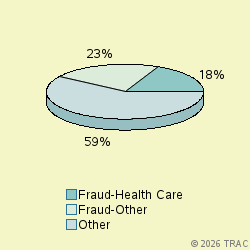
• Federal Procurement Fraud • Federal Program Fraud • Tax Fraud • Arson for Profit • Other Insurance Fraud • Financial Institution Fraud • Bankruptcy Fraud • Advance Fee Schemes • Other Fraud Against Businesses • Consumer Fraud • Securities Fraud • Commodities Fraud • Other Investment Fraud • Antitrust Violations - Other • Computer Fraud • Health Care Fraud • Fraud Against Insurance Providers • Intellectual Property Violations • Insider Fraud Against Insurance Providers • MEWA (Multiple Employer Welfare Arrangements) Fraud/MET • Antitrust Violations - Airlines • Antitrust Violations - Banking • Antitrust Violations - Defense Procurement • Antitrust Violations - Extraterritorial Application Of • Antitrust Violations - Finance Markets, Other than Banking • Telemarketing Fraud • Corporate Fraud • Identity Theft • Aggravated Identity Theft • Other White Collar Crime/Fraud The largest number of prosecutions of these matters in June 2026 was for "Fraud-Other", accounting for 22.7 percent of prosecutions. Prosecutions were also filed for "Fraud-Health Care" (18%), "Fraud-Federal Program" (16.4%), "Fraud-Financial Institution" (14.7%), "Fraud-Other Business" (5.1%), "Fraud-Identity Theft-Aggravated" (4.9%), "Fraud-Consumer" (4.2%), "Fraud-Tax" (4.2%), "Fraud-Securities" (3%). See Figure 2.
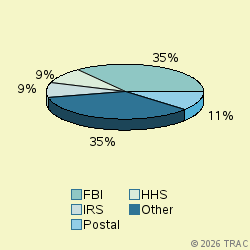
The lead investigative agency for white collar crime prosecutions in June 2026 was FBI accounting for 35 percent of prosecutions referred. Other agencies with substantial numbers of white collar crime referrals were: Postal (11% ), HHS (9%), IRS (9%). See Figure 3.
White Collar Crime Prosecutions in U.S. Magistrate Courts
Top Ranked Lead Charges
In June 2026, 44 defendants in white collar crime cases for these matters were filed in U.S. Magistrate Courts. These courts handle less serious misdemeanor cases, including what are called "petty offenses." In addition, complaints are sometimes filed in the magistrate courts before an indictment or information is entered. In these cases, the matter starts in the magistrate courts and later moves to the district court where subsequent proceedings take place.
In the magistrate courts in June the most frequently cited lead charge was Title 18 U.S.C Section 1343 involving "Fraud by wire, radio, or television". This was the lead charge for 20.5 percent of all magistrate filings in June.
Other frequently prosecuted lead charges include: "18 USC 1028 - Fraud and related activity - id documents" (13.6%), "18 USC 1344 - Bank Fraud" (11.4%).
White Collar Crime Prosecutions in U.S. District Courts
In June 2026, 384 defendants in new cases for these matters were charged in the U.S. District Courts. In addition during June there were an additional 54 defendants whose cases moved from the magistrate courts to the U.S. district courts after an indictment or information was filed. The sections which follow cover both sets of cases and therefore cover all matters filed in district court during June.
Top Ranked Lead Charges
Table 2 shows the top lead charges recorded in the prosecutions of white collar crime matters filed in U.S. District Court during June 2026.
Lead Charge Count Rank 1yr ago 5yrs ago 18 USC 1343 - Fraud by wire, radio, or television 140 1 1 1 More 18 USC 1344 - Bank Fraud 50 2 2 2 More 18 USC 1349 - Mail Fraud - Attempt and Conspiracy 43 3 3 3 More 18 USC 1347 - Health Care Fraud 37 4 8 4 More 18 USC 371 - Conspiracy to commit offense or to defraud US 17 5 5 4 More 18 USC 641 - Public money, property or records 16 6 6 7 More 18 USC 1028A - Aggravated Identity Theft 15 7 15 14 More 18 USC 1028 - Fraud and related activity - id documents 13 8 7 6 More 18 USC 1341 - Mail Fraud - Frauds and swindles 13 8 10 8 More 18 USC 286 - Conspiracy to defraud the Government claims 8 10 79 59 More 26 USC 7206 - Fraud and False statements 8 10 9 9 More Table 2. Top Charges Filed
"Fraud by wire, radio, or television" (Title 18 U.S.C Section 1343) was the most frequent recorded lead charge. "Fraud by wire, radio, or television" (Title 18 U.S.C Section 1343) was ranked 1 a year ago, while it was ranked 1 five years ago.
Ranked 2nd in frequency was the lead charge "Bank Fraud" under Title 18 U.S.C Section 1344. "Bank Fraud" under Title 18 U.S.C Section 1344 was ranked 2 a year ago, while it was ranked 2 five years ago.
Ranked 3rd was "Mail Fraud - Attempt and Conspiracy" under Title 18 U.S.C Section 1349. "Mail Fraud - Attempt and Conspiracy" under Title 18 U.S.C Section 1349 was ranked 3 a year ago, while it was ranked 3 five years ago.
Among these top ten lead charges, the one showing the greatest increase in prosecutions — up 1600 percent — compared to one year ago was Title 18 U.S.C Section 286 that involves " Conspiracy to defraud the Government claims ". This was the same statute that had the largest increase — 750 % — when compared with five years ago.
Again among the top ten lead charges, the one showing the sharpest decline in prosecutions compared to one year ago — down 35.8 percent — was " Conspiracy to commit offense or to defraud US " (Title 18 U.S.C Section 371 ). Compared to five years ago, the most significant decline in prosecutions — 55.8 percent — was for filings where the lead charge was " Fraud and related activity - id documents " (Title 18 U.S.C Section 1028 ).
Top Ranked Judicial Districts
In June 2026 the Justice Department's case-by-case records show that the government brought 154.5 white collar crime prosecutions for every ten million people in the United States.
Understandably, there is great variation in the per capita number of white collar crime prosecutions that are filed in each of the nation's ninety-four federal judicial districts.
The districts registering the largest number of prosecutions per capita for these matters last month are shown in Table 3. Districts must have at least 5 white collar crime prosecutions to receive a ranking.
Judicial District Percapita Count Rank 1yr ago 5yrs ago W Virg, N 1,934 15 1 58 79 More Nevada 1,138 31 2 67 53 More Mo, E 901 22 3 8 18 More Iowa, N 806 9 4 54 60 More N. Y., S 771 34 5 4 6 More Montana 528 5 6 44 44 More Ind, N 496 11 7 58 56 More Texas, N 410 27 8 11 23 More N. Y., N 352 10 9 32 41 More N Car, E 306 11 10 28 44 More Table 3. Top 10 Districts (per ten million people)
The Northern District of West Virginia (Wheeling) — with 1934 prosecutions as compared with 154.5 prosecutions per ten million population in the United States — was the most active during June 2026.
The District of Nevada ranked 2nd.
Eastern District of Missouri (St. Louis) is now ranking 3rd. The Eastern District of Missouri (St. Louis) was ranked 8 a year ago.
Recent entrants to the top 10 list were Northern District of Texas (Fort Worth), now ranked 8th , and Eastern District of North Carolina (Raleigh) at 10th In the same order, these districts ranked 11th and 28th one year ago and 23rd and 44th five years ago.
The federal judicial district which showed the greatest growth in the rate of white collar crime prosecutions compared to one year ago — 216.7 percent — was Nevada . Compared to five years ago, the district with the largest growth — 266.7 percent — was Northern District of West Virginia (Wheeling).
In the last year, the judicial District Court recording the largest drop in the rate of white collar crime prosecutions — 53.8 percent — was Northern District of New York (Syracuse). But over the past five years, Montana showed the largest drop — 31.3 percent.
Top Ranked District Judges
At any one time, there are about 680 federal District Court judges working in the United States. The judges recorded with the largest number of new white collar crime crime cases of this type during June 2026 are shown in Table 4.
Judge Count Rank Pittman, Mark Timothy Texas, N 16 1 More Cote, Denise L. N. Y., S 13 2 More Love, John D. Texas, E 11 3 More Delgado Hernandez, Pedro Alberto Puer Rico 7 4 More Simon, Michael Howard Oregon 5 5 More Brady, Holly Ann Ind, N 4 6 More Morrison, Sarah Daggett Ohio, S 4 6 More Brown, Ada Elene Texas, N 4 6 More Scriven, Mary Stenson Fla, M 3 9 More Altonaga, Cecilia M. Fla, S 3 9 More Fleissig, Audrey Goldstein Mo, E 3 9 More Besosa, Francisco Augusto Puer Rico 3 9 More Pitman, Robert Texas, W 3 9 More Table 4. Top Ten Judges
A total of 5 out of the "top ten" judges were in districts which were in the top ten with the largest number of white collar crime filings per capita, while the remaining 8 judges were from other districts. (Because of ties, there were a total of 13 judges in the "top ten" rankings.)
Judge Mark Timothy Pittman in the Northern District of Texas (Fort Worth) ranked 1st with 16 defendants in white collar crime cases.
Judge Denise L. Cote in the Southern District of New York (Manhattan) ranked 2nd with 13 defendants in white collar crime cases.
Judge John D. Love in the Eastern District of Texas (Tyler) ranked 3rd with 11 defendants in white collar crime cases.
Report Generated: August 12, 2026