Judge Matthew C. Beese
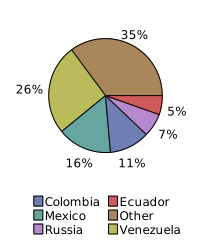
FY 2021 - 2026*, Chicago Immigration Court
*data covers the first 9 months of fiscal year 2026
Published Aug 27, 2026
Matthew Charles Beese was appointed as an immigration judge to begin hearing cases in October 2025. Judge Beese earned an Associate of Arts in 1992 from Northeastern Oklahoma A&M, a Bachelor of Science in Education in 1996 from Missouri Southern State College, and a Juris Doctor in 2002 from Northern Illinois University College of Law. From 2022 to 2025, he served as an administrative law judge with the Oklahoma Corporation Commission. From 2018 to 2022, he served as the municipal judge for the Town of Okay, Oklahoma. From 2010 to 2022, he served as deputy city attorney for Muskogee, Oklahoma. Judge Beese is a member of the Oklahoma Bar.
Deciding Asylum Cases
Detailed data on decisions by Judge Beese were examined for the period covering fiscal years 2021 through the first 9 months of 2026. During this period, court records show that Judge Beese decided 148 asylum claims on their merits. Of these, he granted asylum for 11, granted 10 other types of relief, and denied relief to 127. Converted to percentage terms, Beese denied 85.8 percent and granted 14.2 percent of asylum cases (including forms of relief other than asylum).
Figure 1 provides a comparison of Judge Beese's denial rate each fiscal year over this recent period. (Rates for years with less than 25 decisions are not shown.)
Nationwide Comparisons
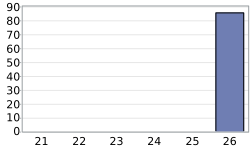
Compared to Judge Beese's denial rate of 85.8 percent, Immigration Court judges across the country denied 62.9 percent of asylum claims during this same period. Judges at the Chicago Immigration Court where Judge Beese decided these cases denied asylum 49 percent of the time. See Figure 2.
Judge Beese's asylum grant and denial rates are compared with other judges serving on the same court in this table. Note that when an Immigration Judge serves on more than one court during the same period, separate Immigration Judge reports are created for any Court in which the judge rendered at least 100 asylum decisions.
Why Do Denial Rates Vary Among Judges?
Although denial rates are shaped by each Judge's judicial philosophy, denial rates are also shaped by other factors, such as the types of cases on the Judge's docket, the detained status of immigrant respondents, current immigration policies, and other factors beyond an individual Judge's control. For example, TRAC has previously found that legal representation and the nationality of the asylum seeker are just two factors that appear to impact asylum decision outcomes.
The composition of cases may differ significantly between Immigration Courts in the country. Within a single Court when cases are randomly assigned to judges sitting on that Court, each Judge should have roughly a similar composition of cases given a sufficient number of asylum cases. Then variations in asylum decisions among Judges on the same Immigration Court would appear to reflect, at least in part, the judicial philosophy that the Judge brings to the bench. However, if judges within a Court are assigned to specialized dockets or hearing locations, then case compositions are likely to continue to differ and can contribute to differences in asylum denial rates.
Representation
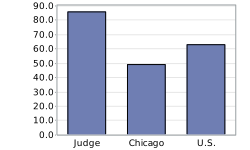
When asylum seekers are not represented by an attorney, almost all of them (74%) are denied asylum. In contrast, a significantly higher proportion of represented asylum seekers are successful. In the case of Judge Beese, 39.9% were not represented by an attorney. See Figure 3. For the nation as a whole, about 18.8% of asylum seekers are not represented.
Nationality
Asylum seekers are a diverse group. Over one hundred different nationalities had at least one hundred individuals claiming asylum decided during this period. As might be expected, immigration courts located in different parts of the country tend to have proportionately larger shares from some countries than from others. And, given the required legal grounds for a successful asylum claim, asylum seekers from some nations tend to be more successful than others.
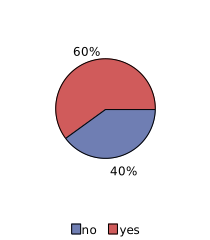
The largest group of asylum seekers appearing before Judge Beese came from Venezuela. Individuals from this country made up 25.7% of his caseload. Other nationalities in descending order of frequency appearing before Judge Beese were: Mexico (15.5%), Colombia (11.5%), Russia (6.8%), Ecuador (5.4%). See Figure 4.
In the nation as a whole during this same period, major nationalities of asylum seekers, in descending order of frequency, were Honduras (10.1%), Guatemala (9.4%), Mexico (9.1%), El Salvador (8.7%), Venezuela (6.8%), Colombia (5.6%), Ecuador (5.3%), Nicaragua (4.8%), India (4.7%), China (4.7%), Russia (3.3%), Brazil (3.2%), Peru (2.9%).