Denaturalization Lawsuits Jump in May and June 2026
Published Jun 17, 2026
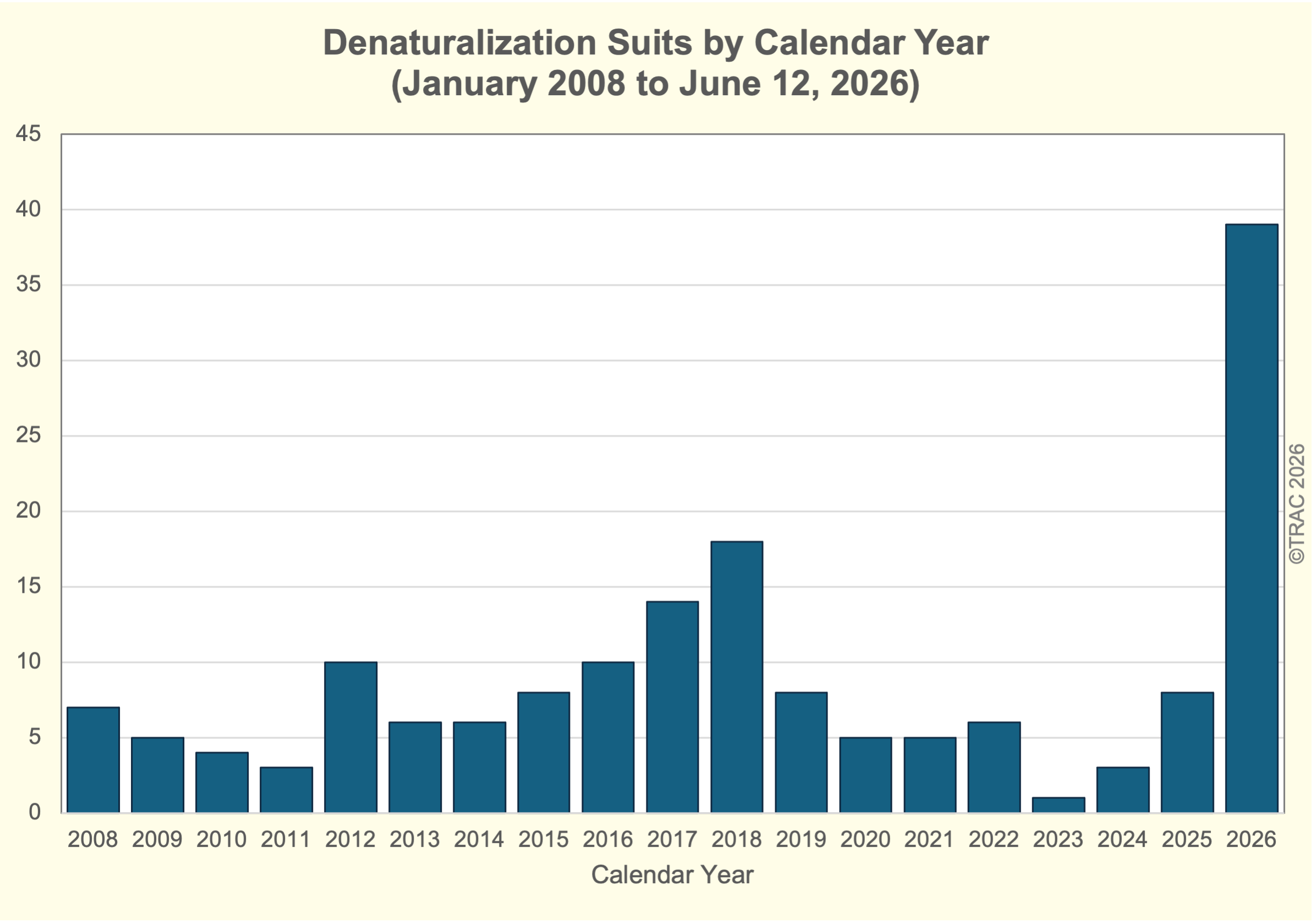
Starting last month, the Trump Administration dramatically increased the number of denaturalization complaints it filed against individuals seeking to revoke their US citizenship. While historically the federal government brought an average of less than 1 denaturalization civil lawsuit per month (or just 0.6), at least 15 denaturalization complaints were filed in May 2026, and 18 have already been filed in the first part of June 2026. See Figure 1.
This report documents an in-depth review of the denaturalization complaints TRAC painstakingly compiled of individuals subject to these civil denaturalization proceedings. (See Appendix A for details on how the data were compiled.)
Grounds Used in Denaturalization Suits
166 denaturalization complaints were identified covering a period from 2008 through June 12, 2026. Denaturalization complaints filed were based on a number of different grounds. These included convictions for significant unlawful acts prior to naturalizing as well as falsely representing their identity in order to obtain naturalization in the first instance.
Grounds also included naturalized citizens who checked “no” on a yes/no box on their naturalization application answering the question whether they had committed any criminal acts for which they had not been arrested or convicted. The response to these questions on the naturalization application provides a very broad rationale for filing a denaturalization action. Many Americans may not realize that very minor violations, violations that even if a person were ticketed and at most might be subjected to a small fine requiring no court appearance, and for which the only notice received was a ticket, may be classified as "crimes" in some jurisdictions including by the federal government. Activities such as speeding, walking a dog not on a leash, or fishing without a valid license may now serve as the basis for the government filing a civil denaturalization complaint in federal courts.[1] Thus, the specific grounds used in filing denaturalization suits bear careful watching.
While the May and June 2026 denaturalization complaints reviewed thus far appear to cover instances of unlawful conduct that clearly warrant initiation of civil denaturalization proceedings, concerns are growing that other less serious or non-criminal conduct may now serve as the basis for a new wave of denaturalization complaints brought against naturalized citizens. This administration has already announced it is currently reviewing a long list of cases for denaturalization.
Historical Roots to Current Denaturalization Actions
Current denaturalization efforts are rooted in a historical initiative referred to as “Operation Janus,” established by the Obama Administration in 2010.[2] Operation Janus was initiated when it was discovered that approximately 206 individuals who had been ordered deported or removed subsequently used a different identity to obtain an immigration benefit.[3] In 2011, a search for individuals who were fugitives, convicted criminals, or had final deportation orders dating back to 1990 was conducted on a Department of Homeland Security (DHS) database. This search revealed approximately 315,000 such individuals without digitized fingerprint records.[4] In response, in 2012, DHS received a $5 million congressional authorization to digitize older paper fingerprint records through a US Immigration and Customs Enforcement (ICE)-led project referred to as Historical Fingerprint Enrollment (HFE).[5] The project digitized approximately 167,000 older fingerprint records before funding ran out and approximately 148,000 older fingerprint records remained undigitized.[6]
The HFE project, even if incomplete, revealed that US Citizenship and Immigration Services (USCIS), the federal agency responsible for naturalization, naturalized approximately 858 individuals who were previously ordered deported or removed under another identity because their fingerprint records were not digitized at the time of naturalization. In a 2016 report, the DHS Office of the Inspector General [OIG] reported that approximately 1,029 individuals with older fingerprint records either had final deportation orders, were criminals or fugitives, and that 858 of the 1,029 fingerprint records were unavailable in IDENT, the system used by DHS to electronically capture fingerprint records at the time the individual naturalized.[7] This same report also revealed that the FBI fingerprint repository was also missing records because, in the past, not all records taken during immigration encounters were forwarded to the FBI.[8]
In 2017, the OIG released a second report on the fingerprint record digitization issue which revealed that as of April 24, 2017, the USCIS had naturalized a total of 2,536 individuals with multiple identities.[9] At the time of the report, the USCIS had developed draft guidance to review the HFE cases to the Department of Justice (DOJ) for civil denaturalization proceedings.
In response to the findings of the 2016 and 2017 OIG reports, the USCIS manually reviewed approximately 2,000 HFE naturalization cases.[10] These cases were identified after the fingerprint records were digitized and included instances where the individual who naturalized was previously ordered deported or removed under a different identity. Approximately 1,600 of these 2,000 cases involved individuals who concealed information and obtained naturalization unlawfully. As of May 2, 2018, the USCIS had referred 89 of these cases to DOJ for possible denaturalization with the goal of referring all 1,600 once these cases were fully reviewed.[11]
To support the ongoing review of naturalized cases where the digitized fingerprint record was unavailable at the time of naturalization, the USCIS created a centralized unit in the USCIS Los Angeles Field Office referred to as the Field Office Directorate (FOD) HFE Unit. In November 2019, the USCIS renamed the FOD HFE Unit to the Benefits Integrity Office (BIO).[12] According to the USCIS Response to the Citizenship and Immigration Services Ombudsman’s 2020 Annual Report to Congress, the USCIS planned to continue reviewing HFE cases and referring them as appropriate to DOJ for civil denaturalization proceedings.
However, the number of denaturalization complaints filed declined precipitously starting in 2019, likely due to a combination of the COVID-19 epidemic and a resulting shortfall in the USCIS fee-based revenue in the summer of 2020.
During the Biden Administration, the number of denaturalization complaints filed remained low, averaging less than 4 per year.[13] Beginning in June 2025, the second Trump Administration reinstituted denaturalization efforts by identifying expansive categories of civil enforcement priorities. On June 11, 2025, the DOJ Civil Division issued a memo outlining several types of civil enforcement priorities, including denaturalization.[14] Notably, amongst the list of 10 categories provided for under denaturalization is: “Any other cases referred to the Civil Division that the Division determines to be sufficiently important to pursue.” The memo concludes by stating that “… the Civil Division retains the discretion to pursue cases outside of these categories as it determines appropriate.” These statements taken together indicate that not only are greater numbers of civil denaturalization proceedings likely to be instituted in the second Trump Administration, but the types of conduct that will form the basis of such proceedings are likely to expand as well.
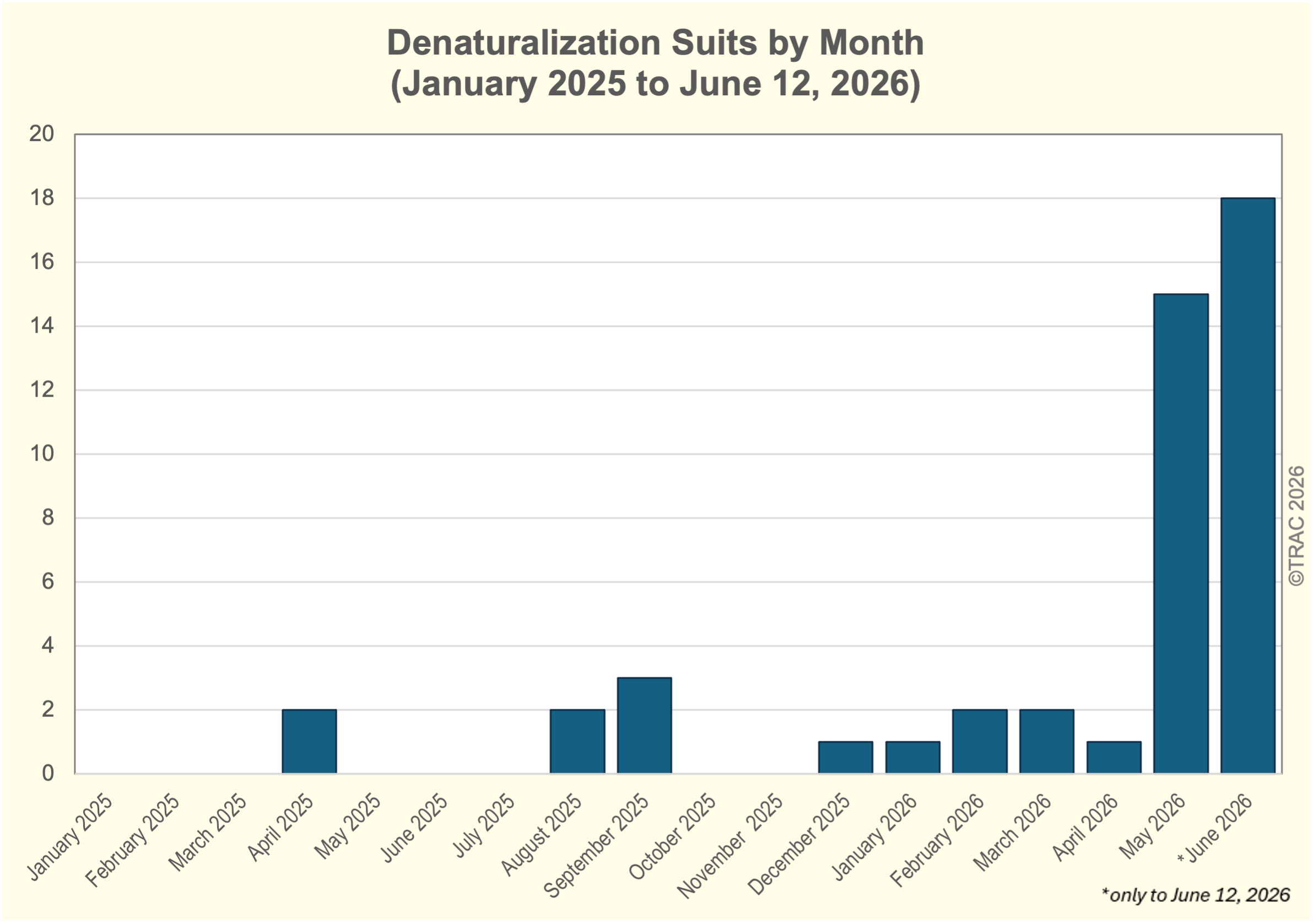
The initial year of the second Trump Administration witnessed little change in the number of denaturalization complaints filed with a total of just eight (8) denaturalization complaints filed in all of 2025. See Figure 2. As noted earlier, however, beginning in May 2026 the DOJ filed 15 denaturalization complaints in succession, and an additional 18 denaturalization complaints have already been filed this month as of June 12, 2026. Three of the denaturalization complaints filed in June 2026 are premised on a false identity claim and indicate that a USCIS fingerprint specialist determined based on a fingerprint analysis that the same individual had previously applied for immigration benefits under a different identity.[15] This trend suggests that USCIS has resumed HFE review.
Underlying Criminal Convictions
Public access to the actual complaints in most of these 166 denaturalization cases is systematically withheld by PACER’s online systems which in a number of judicial districts restricts public access to civil immigration suits. Details about the grounds of a number of these suits were located through searches of DOJ’s past press releases and online searches. Of the 62 for which information on the alleged grounds were located, the bases for civil denaturalization proceedings appear meritorious even including those in the dramatic increase in denaturalization complaints filed in May and June 2026. For the denaturalization complaints that are publicly available, the table below shows a diverse array of underlying criminal convictions that served as the basis for these denaturalization complaints.
Immigration fraud, specifically false identity, was the largest single underlying basis for denaturalization complaints historically and remained so for May and June 2026.[16]
| Underlying Basis of Suit | January 2008 to April 2026 | May 1, 2026 to June 12, 2026 | Total |
|---|---|---|---|
| Wire Fraud/Securities Fraud | 1 | 1 | |
| Child Molestation | 1 | 4 | 5 |
| False Identity/Immigration Fraud | 8 | 6 | 14 |
| Money Laundering | 1 | 1 | |
| Sexual Abuse of a Minor | 1 | 2 | 3 |
| Statutory Rape of a Minor | 1 | 1 | |
| Narcotics Distribution | 2 | 2 | |
| Wire Fraud/Money Laundering | 1 | 1 | |
| Healthcare Fraud | 1 | 1 | |
| Immigration Fraud | 1 | 1 | |
| Terrorism | 2 | 2 | |
| Persecution of Others/Extrajudicial Killings | 1 | 1 | |
| Indecent Conduct | 1 | 1 | |
| Marriage Fraud | 1 | 1 | |
| Wire Fraud | 1 | 1 | |
| Communism/Spying | 1 | 1 | |
| Gun Trafficking | 1 | 1 | 2 |
| Child Sexual Exploitation | 1 | 1 | |
| Gun Trafficking; Healthcare Fraud | 1 | 1 | |
| Identify Theft/Tax Fraud | 1 | 1 | |
| Medicare Fraud | 2 | 2 | |
| Wire Fraud/Theft of Medical Trade Secrets | 2 | 2 | |
| Mail Fraud/Counterfeiting | 1 | 1 | |
| Terrorism/Material Support | 1 | 1 | |
| Forced Labor Conspiracy, False Written Statements | 1 | 1 | |
| Extra Judicial Killing, Misrepresentation | 1 | 1 | |
| Attempted Rape and Attempted Forcible Sodomy | 1 | 1 | |
| Fraud/Misrepresentation | 4 | 4 | |
| False Statements/Bail Jumping/THC Distribution | 1 | 1 | |
| Money Laundering/Wire Fraud/Tax Evasion | 1 | 1 | |
| Racketeering Enterprise | 1 | 1 | |
| Persecution of Others | 1 | 1 | |
| Insurance Fraud | 1 | 1 | |
| Check Fraud | 1 | 1 | |
| Forgery | 1 | 1 | |
| Total | 34 | 28 | 62 |
Causes of Action for Denaturalization Complaints
The cause of action the government has asserted in denaturalization complaints has varied considerably since 2008, presumably depending on the interpretation each United States Attorney gave to the facts of each denaturalization case. Unfortunately, a number of federal judicial districts do not appear to identify a denaturalization-specific cause of action for cases in PACER and instead identify the cause of action as the general jurisdiction of the United States as a plaintiff.[17] In addition, in several instances, even if a denaturalization cause of action was shown, details about the case such as the complaint clearly showed these weren’t denaturalization cases.
The denaturalization statute is codified at 8 U.S.C. § 1451. Subsection (a) of the statute provides for the revocation of naturalization and is the most common cause of action in denaturalization complaints. According to PACER data, the 1451(a) cause of action accounts for approximately 2/3 or 66.27% of the 166 denaturalization complaints filed between 2008 and June 12, 2026, once those incorrectly classified as 1451 cases were dropped. See Figure 3.
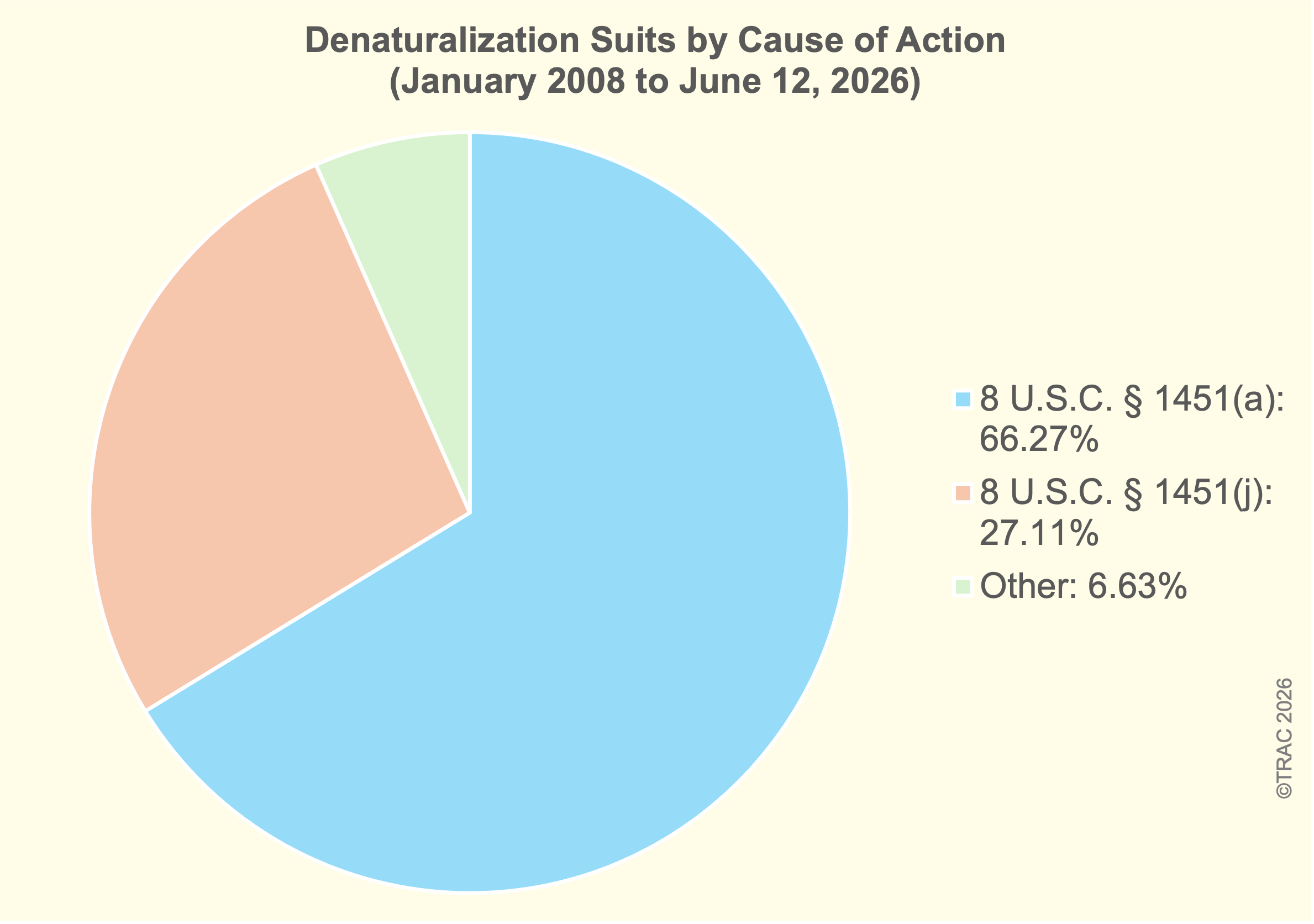
The second-largest number of denaturalization complaints were identified as a cause of action under 8 U.S.C. § 1451(j) and accounted for approximately 27.11% of the 166 denaturalization complaints filed between 2008 and June 12, 2026. The 1451(j) description in PACER, however, is a misnomer because subsection 1451(j) is a historical reference to a subsection of 8 U.S.C. § 1451 that was later reorganized based upon amendments to the denaturalization statute.[18] The current section of 1451 is now subsection (h) which references “the power of the Attorney General to correct, reopen, alter, modify, or vacate an order naturalizing the person.”
A review of the 166 denaturalization complaints filed between 2008 and June 12, 2026 indicates that the determination of which cause of action was chosen as the basis of the denaturalization complaint was not always reliable. The distinction between 1451(a) and 1451(h) lies in the interpretation of whether the denaturalization complaint is to “revoke” a naturalization already granted or to “vacate” a naturalization because the individual was ineligible for naturalization at the time of application. However, a review of PACER case data shows that in several instances the cause of action listed in PACER was logged as a “1451(j)” while the text of the complaint itself indicates 1451(a) as the cause of action.
While the data discrepancies between the DOJ’s labeling of denaturalization complaints into PACER categories and the cause of action identified in the denaturalization complaint itself may initially appear to be de minimis, this distinction actually becomes quite significant when determining whether the naturalized individual will revert to their status as a Lawful Permanent Resident or will have no status and become subject to deportation or removal.[19]
In many of the denaturalization complaints reviewed, particularly those where immigration fraud/false identity was alleged, the cause of action was brought under 1451(a), but the denaturalization complaint alleged that the individual was ineligible for naturalization in the first instance because the individual misrepresented who they were when they applied for their green card. While it would be logical for the denaturalization complaint to allege a cause of action under 1451(h) in these instances, for these cases, the underlying ineligibility to apply for naturalization in the first instance was addressed in the complaint by alleging that the naturalized individual lacked “good moral character,” a provision of the naturalization law codified in 8 U.S.C. § 1427(d). While “good moral character” is an amorphous concept in U.S. immigration law that has been litigated extensively, the general requirement is that the individual engaged in lawful and ethical behavior during the five-year period immediately preceding an application for naturalization or the three-year period if Lawful Permanent Residence was obtained based upon marriage to a U.S. citizen.
For those denaturalization complaints where the underlying basis was a prior criminal conviction, many of these denaturalization complaints were filed years or even decades after the underlying criminal convictions were entered against these naturalized individuals. For these cases, in most instances the United States Attorney relied on section 1451(a) of the statute because that provision incorporates specific language referencing instances where naturalization was “illegally procured or [was] procured by concealment of a material fact or by willful misrepresentation.”
In other words, for most of these denaturalization complaints, it is alleged that at the time the now naturalized individual applied for naturalization, they falsely represented that they had not engaged in criminal activity on Part 9 of the current version of Form N-400 used to apply for naturalization. Again, an argument could be made that section 1451(h) was an appropriate cause of action because the individual was ineligible at the time of application, but this determination appears to have largely been left to the discretion of each United States Attorney.
Conclusion
Denaturalization, once a rare occurrence in federal courts, is now becoming increasingly common. This increase is expected to continue. The combination of the resumption of the HFE project and DOJ’s establishment of denaturalization as a civil enforcement priority has created the administrative processes and infrastructure to support an expansive system for civil denaturalization proceedings.
TRAC has identified this as a new immigration topic that needs ongoing monitoring. As new denaturalization complaints are filed, we plan to update our denaturalization database and periodically publish updated results.
Appendix A: Methodology for Research and Findings
As shared earlier in this report, historically, only a limited number of denaturalization complaints were filed in federal courts and the causes of action under which these cases were brought varied widely. These two factors made it very difficult to conduct a comparative trend analysis to the surge in new denaturalization complaints filed in May and June 2026. In addition of the variance in causes of action, very few of the denaturalization complaints are published, making an analysis of the underlying reason for the civil denaturalization proceeding very challenging.
Given the absence of any known compiled list of civil denaturalization cases filed by the federal government, a manually generated list was painstakingly compiled for this report, focusing on all denaturalization complaints filed from January 2008 to June 12, 2026. The starting point in the compilation of this list was the federal court’s online public access tool (PACER).
Federal civil lawsuits are organized in PACER according to Nature of Suit codes. Nature of Suit codes are established based on the checkbox the person filing the complaint marks on the civil cover sheet. Nature of Suit codes are limited to civil and appellate cases in federal courts and do not include criminal cases. The Nature of Suit code system has two codes for Immigration: code 462 for Naturalization Application and code 465 for Other Immigration Actions. While these Nature of Suit codes are a good starting point, further research revealed that several additional Nature of Suit codes include civil denaturalization cases as well and even codes 462 and 465 include other types of federal lawsuits that are not civil denaturalization cases. Therefore, simply filtering for Nature of Suit codes 462 and 465 alone will not yield a comprehensive list of civil denaturalization cases. For example, the Civil Nature of Suit Code Descriptions, revised in April 2021 reflect that Nature of Suit code 890 includes actions brought pursuant to 8 U.S.C. § 1421, the general delegation of naturalization authority to the Attorney General. Several civil denaturalization cases were filed under this Nature of Suit code as well as code 460, Deportation, which is categorized under the “Other Statutes” group in the Nature of Suit codes system.
To address this shortcoming in the Nature of Suit code system, all lawsuits in Nature of Suit codes 460, 462, 465, and 890 filed between 2008 and June 12, 2026 were individually reviewed in the preparation of this report. After an over-inclusive list of cases was generated for these Nature of Suit codes, the PACER Case Summary screen was reviewed for each case to determine if the case was a civil denaturalization proceeding. This review required the manual querying of hundreds of individual federal civil lawsuits in PACER.
In most instances, the Case Summary screen in PACER includes the statutory provision and subsection for the cause of action. For example, for many of the cases reviewed, a reference to “1451(a)” is presented on the Case Summary screen cause of action field. In other instances, however, no statutory reference is provided. In instances where no statutory reference is provided as the cause of action, many of the cases include language that appears to reference the relevant statutory section. For example, if the language in the cause of action field in the Case Summary screen references “revocation of citizenship,” this is likely a reference to 8 U.S.C. § 1451(a) since that provision contains the word “revocation” in the statutory text. In other instances where no statutory reference for the cause of action is provided, there is language such as “Motion to Correct Order & Judg. of Naturalization.” This is presumably a reference to 8 U.S.C. § 1451(h) since the word “correct” appears in the statutory text of that subsection. In still other instances, No Case Summary screen is available in PACER. In these instances, the Docket Report screen was reviewed to determine if there was language in the “Docket Text” fields that indicates whether the case is a civil denaturalization proceeding. Each federal district court defines its own list of the “cause of action” phrases it uses, so these phrases are not consistent across all federal courts.
In all instances, including those where the case was reviewed in PACER, a separate search of the Office of the United States Attorneys (USAO) website newsroom was conducted for available press releases related to each case. Many of these press releases include additional details about the basis for the denaturalization complaint and some even include links to the denaturalization complaint itself. Where a press release and/or denaturalization complaint is available on the USAO website, links to the materials were captured as part of the denaturalization complaint case list.
In still other instances, there is no information available in either the Case Summary and the Docket Report in PACER, and no press release or other information is available on the USAO website. In these instances, a search of either the Justia or PacerMonitor websites was conducted in an effort to determine if the case was a civil denaturalization proceeding.
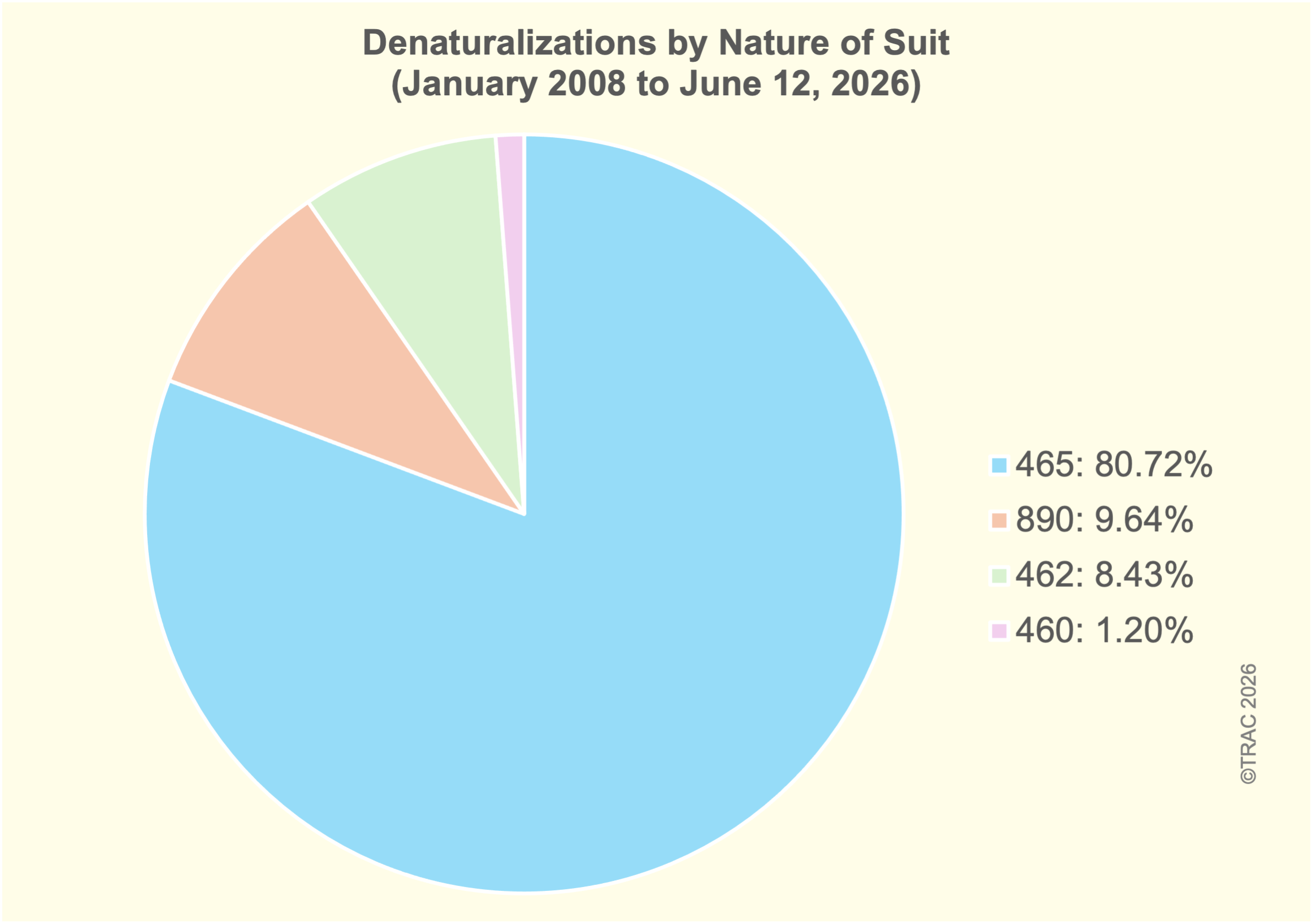
The denaturalization complaint case list includes hundreds of separate federal civil lawsuits. After reviewing many of the cases categorized under Nature of Suit codes 460, 462, 465, or 890, it was determined that the case was not a civil denaturalization proceeding. The 166 denaturalization complaints filed between 2008 and June 12, 2026 that were reviewed for this report reflects that approximately 80.72% of the denaturalization complaints were filed under code 465. The second-highest percentage of the 166 denaturalization complaints reviewed were categorized under code 890. The third-highest Nature of Suit code percentage is 462. Collectively, these three Nature of Suit codes constitute approximately 98.80% of the 166 denaturalization complaints filed between 2008 and Jun 12, 2026.
The 166 denaturalization complaints filed between 2008 and June 12, 2026 that were reviewed for this report reflect that approximately 80.72% of the denaturalization complaints were filed under code 465.
For the May and June 2026 denaturalization complaints, approximately 93.94% were filed under code 465. It is too soon to determine whether this will be a continuing trend, given the greater level of coordination in bringing of these suits given that denaturalization is now a civil enforcement priority for DOJ. The remaining 6.06% of the May and June 2026 denaturalization complaints were filed under code 890.
Crosswalk of Causes of Action with Nature of Suit Codes
It is anticipated that going forward, that as an incresing number of denaturalization complaints are filed, they will be categorized under the Nature of Suit code of 465. A review of the 166 denaturalization complaints filed between January 2008 and June 12, 2026 reflects that approximately 76.51% of the denaturalization complaints were filed under a cause of action of 8 U.S.C. § 1451(a) or 8 U.S.C. § 1451(j) with a Nature of Suit code of 465. When this analysis is narrowed to just the May and June 2026 denaturalization complaints, this percentage rises to 81.82%. Again, this pattern suggests a level of coordination in the filing of denaturalization complaints as the current Administration ramps up efforts to bring more of these cases in federal courts.
Appendix B: Developing a Comprehensive Database for Denaturalization Lawsuits
| Cause of Action | Nature of Suit | Count | Percentage |
|---|---|---|---|
| 18 U.S.C. § 1546(a); 8 U.S.C. § 1451(a) | 465 | 1 | 0.60% |
| 28 U.S.C. § 1345 | 465 | 3 | 1.81% |
| 8 U.S.C. § 1151 | 465 | 1 | 0.60% |
| 8 U.S.C. § 1158 | 465 | 1 | 0.60% |
| 8 U.S.C. § 1451(a) | 465 | 94 | 56.63% |
| 8 U.S.C. § 1451(a) | 890 | 7 | 4.22% |
| 8 U.S.C. § 1451(a) | 462 | 7 | 4.22% |
| 8 U.S.C. § 1451(a) | 460 | 2 | 1.20% |
| 8 U.S.C. § 1451(b) | 890 | 4 | 2.41% |
| 8 U.S.C. § 1451(j) | 465 | 33 | 19.88% |
| 8 U.S.C. § 1451(j) | 462 | 7 | 4.22% |
| 8 U.S.C. § 1451(j) | 890 | 5 | 3.01% |
| Civil Miscellaneous Case | 465 | 1 | 0.60% |
| Total | 166 | 100.00% |
| Cause of Action | Nature of Suit | Count | Percentage |
|---|---|---|---|
| 28 U.S.C. § 1345 | 465 | 1 | 3.03% |
| 8 U.S.C. § 1151 | 465 | 1 | 3.03% |
| 8 U.S.C. § 1158 | 465 | 1 | 3.03% |
| 8 U.S.C. § 1451(a) | 465 | 23 | 69.70% |
| 8 U.S.C. § 1451(a) | 890 | 2 | 6.06% |
| 8 U.S.C. § 1451(j) | 465 | 4 | 12.12% |
| Civil Miscellaneous Case | 465 | 1 | 3.03% |
| Total | 33 | 100% |