As Denaturalization Lawsuits Surge, Their Basis Lacks Transparency
Published Aug 21, 2026
Denaturalization remains an ongoing Department of Justice (DoJ) civil enforcement priority. In July 2026 at least 50 denaturalization complaints were filed in that single month, an all-time high. This brought the total during the first seven months of 2026 to at least 105 denaturalization suits filed this year.[1] Yet despite this surge in denaturalization suits, the government has released very little information about the underlying basis for these suits and current rules prevent public access to almost all of these court filings.
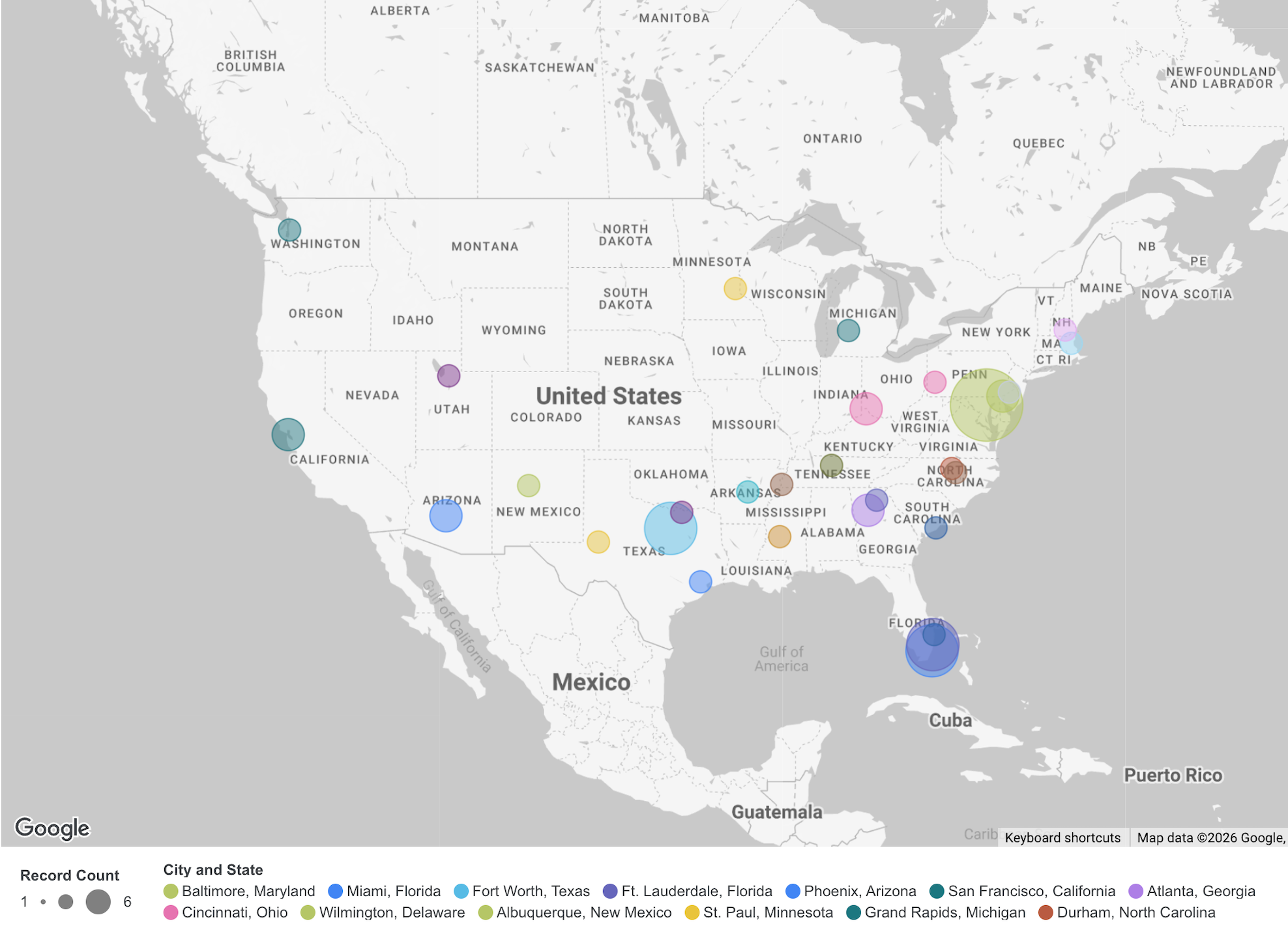
Suits were filed in 23 states during the month of July 2026 alone. Seven of these states had not seen any denaturalization suits filed previously in records stretching back to 2008. The largest number of denaturalization suits identified in July were filed in Florida (9), Texas (7), and Maryland (6). California, which had seen numerous denaturalization suits in the past, saw only two (2) new suits filed in July; and both New York and Illinois had none. Figure 1 displays the states and federal judicial districts which have had denaturalization suits in July.
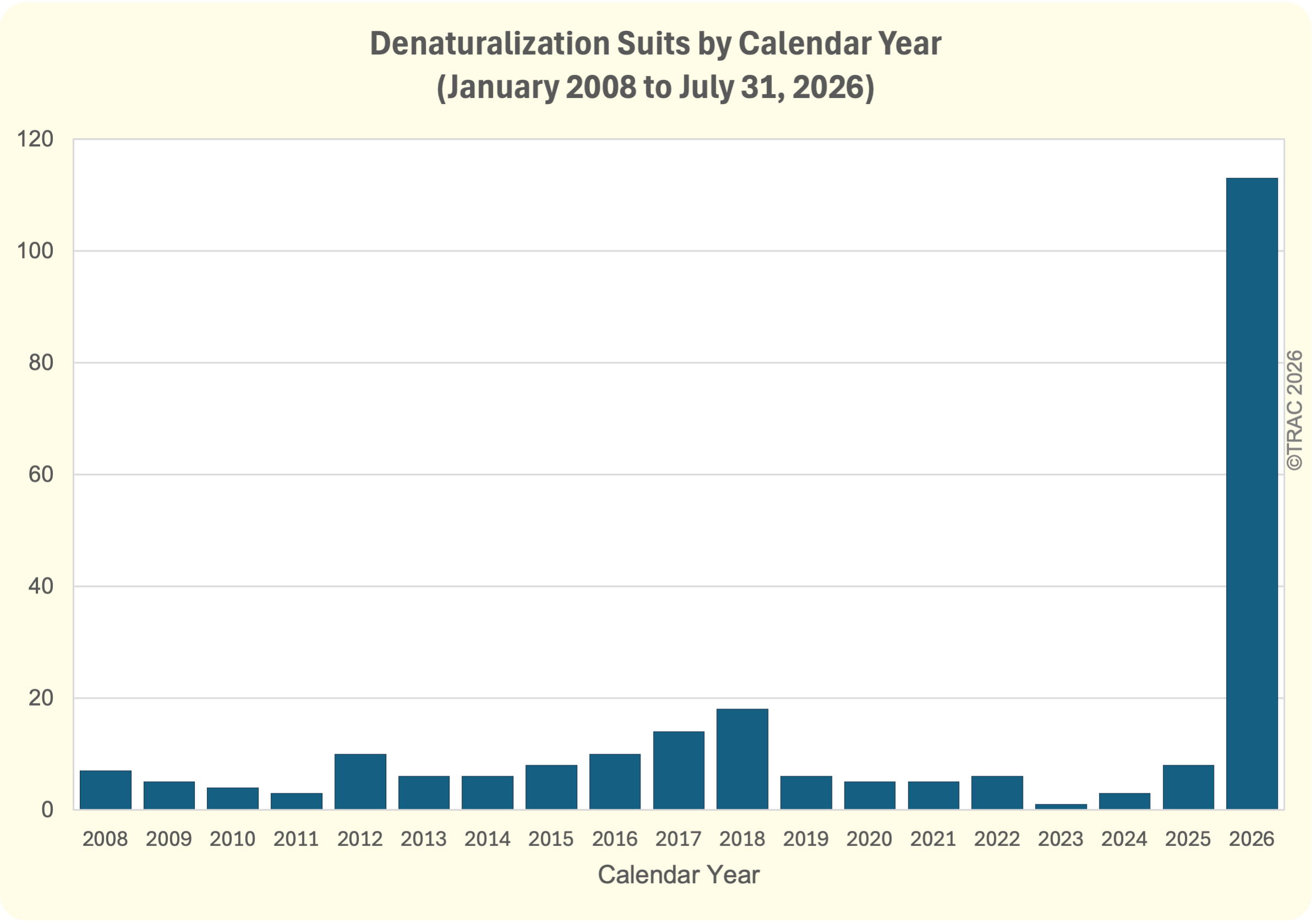
Thirty-six (36) states plus the District of Columbia saw federal actions in their communities to strip naturalized citizens of their citizenship over this entire period. The largest number of suits have been filed in Florida where a total of 49 have been filed since 2008. Across this entire period, California was second with a total of 26 denaturalization suits filed and Texas was third with 16 denaturalization suits filed. See Table 1 for a state-by-state breakdown for the entire period. Figure 2 shows the dramatic growth in denaturalization filings this year.
| State | 2008-2025 | 2026 | Total | |
|---|---|---|---|---|
| January - June | July | |||
| Alaska | - | - | 1 | 1 |
| Arizona | - | - | 2 | 2 |
| Arkansas | - | - | 1 | 1 |
| California | 21 | 3 | 2 | 26 |
| Colorado | 3 | 1 | - | 4 |
| Connecticut | 1 | 2 | - | 3 |
| Delaware | - | 1 | 2 | 3 |
| District of Columbia | 8 | 1 | - | 9 |
| Florida | 30 | 10 | 9 | 49 |
| Georgia | 6 | 4 | 3 | 13 |
| Illinois | - | 2 | - | 2 |
| Indiana | 1 | - | - | 1 |
| Iowa | 3 | 2 | - | 5 |
| Kansas | 7 | 1 | - | 8 |
| Kentucky | 1 | - | - | 1 |
| Maryland | - | 4 | 6 | 10 |
| Massachusetts | - | - | 1 | 1 |
| Michigan | - | - | 1 | 1 |
| Minnesota | 5 | 2 | 1 | 8 |
| Mississippi | - | 1 | 1 | 2 |
| Missouri | - | 2 | - | 2 |
| Nevada | - | 1 | - | 1 |
| New Hampshire | 1 | - | 1 | 2 |
| New Jersey | 1 | 1 | 1 | 3 |
| New Mexico | - | - | 1 | 1 |
| New York | 8 | 3 | - | 11 |
| North Carolina | 3 | 3 | 2 | 8 |
| Ohio | 1 | - | 2 | 3 |
| Oklahoma | - | 1 | - | 1 |
| Oregon | 7 | 1 | - | 8 |
| Pennsylvania | - | 4 | 1 | 5 |
| South Carolina | - | - | 1 | 1 |
| Tennessee | - | 1 | 2 | 3 |
| Texas | 6 | 3 | 7 | 16 |
| Utah | 1 | - | 1 | 2 |
| Washington | 6 | - | 1 | 7 |
| Wisconsin | 5 | 1 | - | 6 |
| Total | 125 | 55 | 50 | 230 |
True Number of Suits Lacks Transparency
The true number of denaturalization suits may be higher since there is no reliable way to identify every court action. While claiming that it is filing a record number of denaturalization suits, the DoJ is highly selective about which suits it publicizes and which ones it fails to make public. For example, the DoJ issued press releases on July 20, 2026, and August 3, 2026, purporting to describe each denaturalization suit it recently filed. However, for all of July, these press releases listed just 29 denaturalization suits when it appears at least 50 were actually filed for that month. Clearly, the DoJ cannot be relied upon to publish a comprehensive list.
While federal courts are usually assumed to make court records readily accessible to ensure citizens and the press can monitor the integrity of the federal judicial system, the U.S. courts in fact severely restrict public access to court actions seeking to strip individuals of their citizenship. Unlike most court records which are available online, denaturalization complaints setting forth the government’s allegations fall under special provisions[2] that block public access allegedly to protect personal privacy.[3]
Assuring public access to the denaturalization complaints is clearly vital. A court filed complaint is largely the sole means of systematically monitoring these actions. It is clearly preposterous to block public access to this information on privacy grounds while at the same time the DoJ is publicizing the names and alleged violations of these same individuals in its press releases. Without access to the complaint, the public has little means to check that a press release fairly and fully describes the rationale for the government’s action.
Further, without access to the complaints, it is difficult even to identify denaturalization suits when they are filed. While the federal courts online system called PACER tags each civil filing by a “nature of suit” code, these are not always reliably assigned and there is no nature of suit code that specifically identifies denaturalization suits.[4]
The methodology TRAC used to compile its list of denaturalization cases filed since 2008 is described in Appendix A in its June 17, 2026, report. Through these painstaking efforts reviewing federal court dockets, TRAC identified 21 additional denaturalization cases filed during July 2026 beyond the 29 listed in the DoJ’s press releases. See Appendix.
However, there is no assurance that this is the complete set of denaturalization cases. Indeed, at least one of the cases identified in DoJ’s latest press release could not be located through a PACER search as of the date of this report. Further, when the person’s identity is not released, the available court docket information is limited and therefore may be insufficient to pinpoint a denaturalization filing.[5]
Denaturalization Grounds Lack Transparency
Because of these access barriers, only two of the 50 complaints filed in July were available through a search of court records. As a result, the public is largely left in the dark on the grounds the government used and the reasons why it chose these individuals to pursue denaturalization.
DoJ’s press releases for denaturalization complaints filed during July 2026 cited alleged convictions for significant unlawful acts prior to naturalizing and/or falsely representing their identity to obtain naturalization in the first instance. Most denaturalization complaints featured in these press releases, however, were premised on unlawful conduct versus false identity.
Unlike the earlier denaturalization cases shared in TRAC’s initial report, sexual abuse of a minor or similar conduct was the largest single underlying basis for denaturalization complaints filed in July 2026. Given that the DoJ was highly selective in which lawsuits were publicized, it is impossible to say whether sexual abuse cases were cited because it chose to feature lawsuits based on these grounds or this was generally true for denaturalization lawsuits that the administration filed during July 2026.
Extraordinary Efforts Required to Obtain Denaturalization Complaints Directly from Courts Yielding Divergent Responses
After publishing its first report on denaturalization suits, TRAC launched a project to obtain copies of unavailable denaturalization complaints directly from the federal judicial district where they were filed. A series of letters listing the cases in which complaints were sought were written and emailed to the court clerk in each of 37 separate federal judicial districts. The courts’ responses to TRAC’s requests, including the process required, varied widely from one court to the next.
In total, these letters sought copies of 142 denaturalization complaints. These covered all complaints which TRAC had been unable to obtain covering the period January 2008 through June 14, 2026, discussed in TRAC’s June 17, 2026, report. This effort is still ongoing as some courts have not yet provided copies of the complaint or advised that they wouldn’t be able to send them.
For forty (40) of the requested complaints, the court responded that they could not furnish us copies. The reasons given were as follows:
- For nineteen out of these forty, TRAC was advised that someone would have to travel to the court and obtain copies by using public terminals at the courthouse.
- For an additional four of these requested denaturalization complaints, TRAC was advised that these could only be viewed on public terminals at the courthouse, but that copies were not permitted, just viewing.
- For nine further complaints, the court advised that copies could only be obtained either by a motion to the court or from the parties themselves.
- For the remaining eight of these requested denaturalization complaints, TRAC was advised that the complaints were unavailable altogether.
As of the date of this report, TRAC successfully obtained forty-three (44) of the requested denaturalization complaints without traveling to the courthouse. It is disappointing that just 44 out of the 142 complaints sought, just 31% have been provided.
As of the date of this report, a total of $1,496.00 was paid for copies of these 44 complaints, or an average of $34 per case. Most charged a copying fee of $0.50 per page and the payment had to be received by the court before copies were released. Only six charged the standard PACER rate of $0.10 per page. One court did offer a free courtesy copy, however, future requests for docket sheets, transcripts, or other documents require prepayment of copy expense at $0.50 per page. None of the other courts offered to waive or cap the fee even though PACER has provisions for doing this for electronic access. For those denaturalization complaints that were often very lengthy, fees were as high as $719.00 from one court for copies of multiple complaints. This can be a considerable financial cost barrier limiting public access to these records. Apart from copying fees, occasionally other charges were imposed. These included electronic retrieval charges, additional search fees, and certified copy fees from a several of the courts.
Considerable delays were inevitably involved before complaints were received. Only five courts allowed electronic payment, so checks had to be physically sent and received by the court before complaints were provided. And only five courts were willing to provide digital copies, the rest only made paper copies. Often considerable back and forth communications has had to be exchanged with the court clerk.
This cost assessment omits both the administrative overhead of managing court communications and the technical infrastructure required to sustain this project. Other administrative expenditures include PACER fees, postage, certified check processing fees, office supplies, and staff time.
Considerable time and effort required to communicate with each court. The process of identifying which complaints were within the jurisdiction of each district and then preparing letters to each of these courts was a significant administrative undertaking that would have otherwise been unnecessary in the absence of current public records access policies.
Conclusion
In July 2026 the increase in denaturalization complaints filed continued unabated and reached what appears to be an all-time high. At the same time, the government provided even less transparency as to the underlying bases for these suits. The establishment of denaturalization as a civil enforcement priority now includes robust administrative processes and infrastructure to support an expansive system for civil denaturalization proceedings for which the government provides little publicly accessible information. This lack of transparency should concern all citizens.
Continued empirical monitoring of this administration’s efforts to strip individuals of their citizenship will be increasingly important.
Appendix: Methodology Using Court Docket Information and Nature of Suit Codes
Federal civil lawsuits are organized in PACER according to nature of suit codes. Nature of suit codes are assigned based on the checkbox the person filing the complaint marks on the civil cover sheet. For this updated report, these three nature of suit codes were again used:
- 462: Naturalization Application
- 465: Other Immigration Action
- 890: Other Statutory Actions
TRAC examined every case listed under each of these three codes and reviewed the PACER Docket Report screen to determine whether the case was a civil denaturalization proceeding. This over-inclusive review required manual querying and reviewing large numbers of individual federal civil lawsuits in PACER.
In most instances, the Docket Report screen in PACER includes the statutory provision and subsection for the cause of action. For example, for many of the cases reviewed, a reference to “1451(a)” is presented on the Docket Report screen cause of action field. In other instances, however, no statutory reference is provided.[6]
In instances where no statutory reference is provided as the cause of action, many of the cases include language that appears to reference the relevant statutory section. For example, if the language in the cause of action field in the Docket Report screen references “revocation of citizenship,” this is likely a reference to 8 U.S.C. § 1451(a) since that provision contains the word “revocation” in the statutory text. In still other instances where no statutory reference for the cause of action is provided, there is language such as “Motion to Correct Order & Judg. of Naturalization.” This is presumably a reference to 8 U.S.C. § 1451(h) since the word “correct” appears in the statutory text of that subsection.
For the period January 1, 2008 to July 31, 2026, the denaturalization complaint case list now includes a total of 229 identified civil denaturalization cases.[7] Of these 229 cases, 137 or 59.83% of the cases were filed under a cause of action of 8 U.S.C. § 1451(a) and 56 or 24.45% were filed under a cause of action of 8 U.S.C. § 1451(j). These two causes of action together account for 193 or 84.28% of the 229 denaturalization cases reviewed.
For July alone, approximately 19 of the 49 denaturalization cases were filed under 8 U.S.C. § 1451(a) and 9 were filed under 8 U.S.C. § 1451(j). Together, these two causes of action account for 28, or 57.14% of the denaturalization cases reviewed. Notably, this is a much lower percentage than it was for the entire period from 2008 through July.
Over eight out of ten (85.59%) of the 229 denaturalization complaints filed between 2008 and July 31, 2026 reviewed for this updated report were filed under a nature of suit code 465. For those filed during July 2026, all but two were filed under this nature of suit.
Between 2008 and July 31, 2026, 7.86% were categorized under the miscellaneous code 890, while 5.68% were assigned nature of suit code 462. Two suits, or 0.87% of the denaturalization complaints were filed under code 460. Two suits were filed under one of the above nature of suit codes, but were subsequently determined not to be denaturalization complaints upon further review of information contained in the Docket Report screen of PACER.
Appendix Tables 1 and 2 provide a crosswalk between the cause of action and the nature of suit codes assigned.
| Cause of Action | NoS | Count | Percentage |
|---|---|---|---|
| 18 U.S.C. § 1546(a); 8 U.S.C. § 1451(a) | 465 | 1 | 0.44% |
| 28 U.S.C. § 1331 | 465 | 9 | 3.93% |
| 28 U.S.C. § 1331 | 890 | 1 | 0.44% |
| 28 U.S.C. § 1345 | 465 | 12 | 5.24% |
| 8 U.S.C. § 1101 | 465 | 2 | 0.87% |
| 8 U.S.C. § 1151 | 465 | 1 | 0.44% |
| 8 U.S.C. § 1158 | 465 | 1 | 0.44% |
| 8 U.S.C. § 1421 | 465 | 1 | 0.44% |
| 8 U.S.C. § 1445 | 465 | 1 | 0.44% |
| 8 U.S.C. § 1451(a) | 465 | 121 | 52.84% |
| 8 U.S.C. § 1451(a) | 890 | 8 | 3.49% |
| 8 U.S.C. § 1451(a) | 462 | 6 | 2.62% |
| 8 U.S.C. § 1451(a) | 460 | 2 | 0.87% |
| 8 U.S.C. § 1451(b) | 890 | 4 | 1.75% |
| 8 U.S.C. § 1451(j) | 465 | 44 | 19.21% |
| 8 U.S.C. § 1451(j) | 462 | 7 | 3.06% |
| 8 U.S.C. § 1451(j) | 890 | 5 | 2.18% |
| Civil Miscellaneous Case | 465 | 3 | 1.31% |
| 229 | 100.00% |
| Cause of Action | NoS | Count | Percentage |
|---|---|---|---|
| 28 U.S.C. § 1331 | 465 | 7 | 14.29% |
| 28 U.S.C. § 1331 | 890 | 1 | 2.04% |
| 28 U.S.C. § 1345 | 465 | 9 | 18.37% |
| 8 U.S.C. § 1101 | 465 | 2 | 4.08% |
| 8 U.S.C. § 1445 | 465 | 1 | 2.04% |
| 8 U.S.C. § 1451(a) | 465 | 18 | 36.73% |
| 8 U.S.C. § 1451(a) | 890 | 1 | 2.04% |
| 8 U.S.C. § 1451(j) | 465 | 9 | 18.37% |
| Civil Miscellaneous Case | 465 | 1 | 2.04% |
| 49 | 100.00% |